How we are working to reduce our impact, support local conservation, and contribute to practical nature action in Mongolia and Devon.
Mongolia’s landscapes are at the heart of almost every journey we offer.
The open steppe, Gobi desert, mountain forests, wetlands, river valleys, and high-altitude landscapes are not simply a backdrop for tourism. They support wildlife, livestock, water sources, local livelihoods, and communities whose lives remain closely connected to the land.
They are also under increasing pressure.
Climate change, mining, infrastructure development, overgrazing, water scarcity, waste, and changes in land use are affecting habitats across Mongolia. These pressures do not exist separately. Damage to pasture affects livestock and herding families. Changes to water sources affect both people and wildlife. Habitat fragmentation places further pressure on already vulnerable species.
Tourism is now part of that pressure too. Visitor numbers are rising, while much of Mongolia’s tourism industry remains relatively unregulated. More vehicles, more camps, more waste, and more repeated use of the same landscapes and communities can all have consequences, especially when growth happens faster than planning, infrastructure, or environmental safeguards.
We do not claim that tourism is automatically good for nature. Every journey has an impact through transport, food, water use, waste, accommodation, and the places we choose to visit.
Our responsibility is to understand those impacts better, reduce them where we can, and support people and organisations already working to protect Mongolia’s landscapes and wildlife..
Mongolia lies where the Central Asian steppe, Siberian taiga, and Gobi Desert meet, creating a remarkable range of landscapes and habitats.
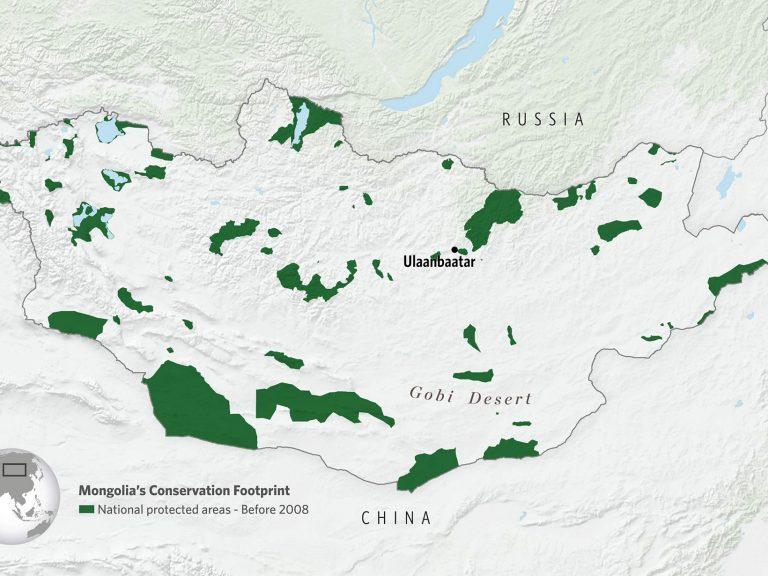
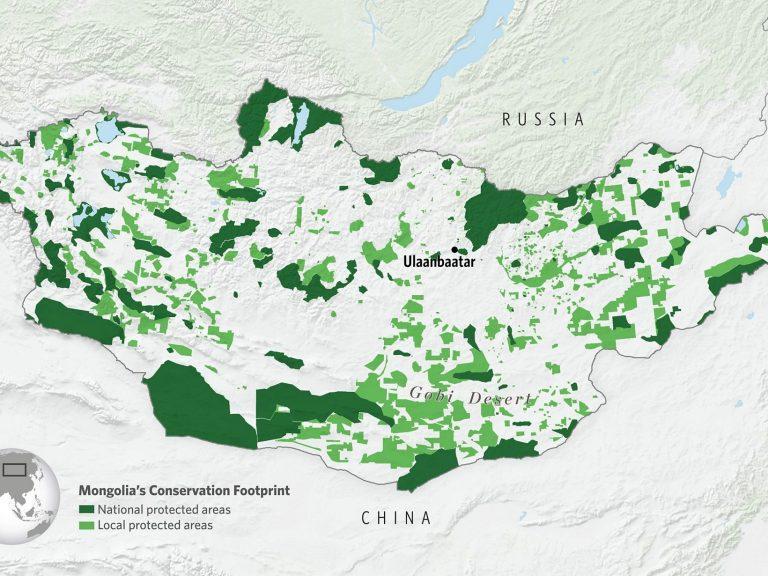
Around 20% of the country is currently under national protection, with a target of 30% by 2030. Mongolia’s ecological importance is also recognised through its UNESCO World Heritage Sites, Ramsar wetlands, biosphere reserves, Important Bird Areas, and WWF Global 200 ecoregions.
Protected status can help limit mining, logging, excavation, and other damaging activities. But protection on paper is only part of the answer. These landscapes also need monitoring, funding, research, and the involvement of the communities who live within and around them.
The following maps help show the scale and importance of these protected and internationally recognised landscapes.
A comparison of protected areas before 2008 and in 2020. Maps from The Nature Conservancy.
Tourism affects nature in many ways, not only through wildlife encounters.
Transport, accommodation, food, water use, waste, plastic, noise, lighting, and new infrastructure all leave a footprint. Even small decisions can add pressure, especially in places where waste systems, roads, water supplies, and environmental safeguards are limited.
This means responsibility for nature cannot sit only with wildlife tours or organisations labelled as ecotourism. It needs to be part of how every journey is designed and operated.
Tourism depends on healthy landscapes and communities. We therefore have a responsibility to think carefully about the places we visit, the resources we use, the pressure we create, and who benefits from the journey.
We cannot make travel impact-free. But we can reduce unnecessary harm, support conservation and local action, and be honest about the compromises involved.
We look carefully at where we travel, how often we visit, who is involved, and what pressure an experience may create.
We keep our groups small, limit the number of departures we operate, and work through long-term relationships rather than continually searching for new places and communities to market.
We favour slower journeys and more time in each region rather than short itineraries built around moving quickly between highlights.
We also approach wildlife experiences carefully. Sightings cannot be guaranteed, and the welfare of the animal and its habitat must come before getting closer or obtaining a photograph.
Our climate commitments sit alongside this work. We are a signatory to the Glasgow Declaration and were a member of Get Nature Positive before the initiative was absorbed into wider work.
We do not see either as a badge. They are frameworks that encourage us to keep questioning our impact and taking practical action rather than making claims we cannot support.
Although Mongolia is known internationally for its open landscapes, around half of the country’s population lives in Ulaanbaatar.
Many children in the city have limited access to green spaces, nature-based activities, or clubs that help them explore the environment around them. This was the motivation behind the Heroes of Nature Eco Club, which we developed in partnership with the Association Goviin Khulan.
The club was designed as a free nature programme for children growing up in an urban environment. Its purpose was not only to teach facts about wildlife, but to help children feel that Mongolia’s nature belongs to them too and that they have a role in its future.
Our first projects gave us the opportunity to test ideas and learn what worked. We are now taking time to identify the right community location and partnership through which the club can grow more sustainably.
We do not want to continue simply for the sake of saying that a project exists. It needs a suitable local base, people who can support it consistently, and a structure that works for the children and community involved.
The Heroes of Nature Eco Club remains part of our longer-term plans, and we hope to develop its next stage when the right partnership and location are in place.
We work with people and organisations whose conservation work is rooted in local knowledge and long-term involvement.
One of these is the Association Goviin Khulan, a grassroots Mongolian organisation working to protect the khulan, or Mongolian wild ass, and its habitat.
Its work recognises that wildlife conservation cannot be separated from the needs and experiences of local communities. Research, education, local participation, and an understanding of the pressures people face all form part of protecting the wider landscape.
In western Mongolia, we also work with a community of herders who have received training and support to monitor snow leopards and other wildlife.
Their knowledge of the mountains, animal tracks, weather, and seasonal movement is built through daily experience of the landscape. Some also work as wildlife spotters, giving travellers the chance to learn from people who know the region intimately.
This creates an additional source of local income, but it is important not to romanticise it. Wildlife tourism alone cannot protect snow leopards, and the presence of visitors must not place additional pressure on the animals.
The value lies in supporting people who already live alongside wildlife and whose involvement is essential to its long-term protection.
Our responsibility to nature does not begin and end when a journey enters or leaves Mongolia.
Since the pandemic, Jess has spent more time in Devon while supporting her mother. Wanting to contribute to the place where she was living, she joined with a local parish councillor and conservationist to establish Wild Oke, Okehampton’s community wildlife group.
Wild Oke is small, local, and practical. It brings together people who care about nature and want to make a difference within their own community as well as creating opportunities for residents to learn more about the wildlife living alongside.
The group organises talks, activities, awareness campaigns, and community events in partnership with local people and organisations. It also offers practical support to projects that benefit wildlife, habitats, and access to nature.
The aim is not to create large, headline-making projects. It is to help people act on what they can influence: creating and protecting habitats, planting for pollinators, improving spaces for wildlife, sharing practical advice, and supporting organisations already doing important work.
Wild Oke is also about making nature more visible in everyday community life.
Not everyone sees themselves as a conservationist, and not everyone has the time or resources to join a formal environmental organisation. A local wildlife group can offer more accessible ways to become involved, whether by attending a talk, joining an event, sharing a sighting, changing something in a garden, volunteering for a few hours, or supporting a local project.
Wild Oke reflects the same principle that shapes much of our work in Mongolia: lasting change is usually built through relationships, local knowledge, and steady practical action rather than one-off gestures.
Nature protection is not a separate part of our business or something that can be reduced to a single project.
It influences where we travel, who we work with, how many guests we bring, what we ask of local communities, and how honestly we talk about tourism’s impact.
We are still learning. Some projects will change, some partnerships will develop, and some ideas may prove not to be the right fit.
Our aim is not to suggest that we have solved the problem. It is to remain involved, listen to people with greater knowledge and experience, and continue taking practical action in Mongolia and in the communities we are part of at home.