


Bayanzag or the Flaming Cliffs – What’s in a Name?
The name Flaming Cliffs was given to the red sandstone formations by the American explorer Roy Chapman Andrews during his expeditions to Mongolia in the 1920s.
It refers to the colours of the cliffs, particularly in the late afternoon and evening when the sandstone can take on deep shades of red and orange. However, the Mongolian name for the area is Bayanzag, meaning ‘rich in saxaul’.
I have always liked this distinction. The English name draws attention to the dramatic appearance of the rock formations, while the Mongolian name reflects a different relationship with the landscape – one that recognises the importance of the vegetation growing there.
Saxaul, known locally as zag, is a hardy desert tree or shrub adapted to the dry conditions of the Gobi. It provides habitat and shelter for wildlife and plays an important role in the wider desert ecosystem.

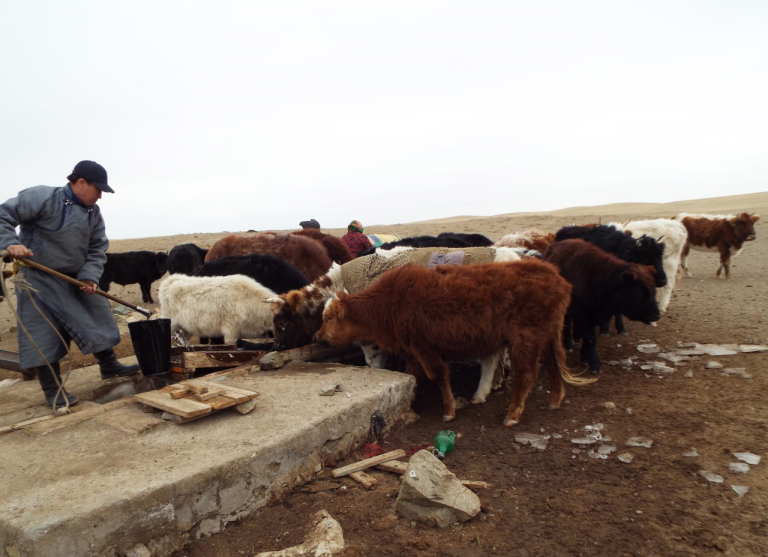
For herding families, the presence of vegetation and the availability of pasture and water are practical considerations that have shaped how people live and move through the region.
Bayanzag is therefore more than a collection of spectacular red cliffs. It is part of a larger living landscape.
Do the Flaming Cliffs Really Look as Though They Are on Fire?
Sometimes, yes. But not always. The colour of the sandstone changes with the light, and on certain evenings the cliffs can appear to glow with an extraordinary intensity. On other days, particularly under a pale or overcast sky, the colours are much more subdued.
Roy Chapman Andrews captured this variation in his book The New Conquest of Central Asia, describing how the cliffs change from relatively flat-looking formations in the midday light to deeper reds and dramatic shadows when the sun is low.
‘Like a fairy city, it is ever changing. In the flat light of midday the strange forms shrink and lose their shape; but when the sun is low the Flaming Cliffs assume a deeper red, and a wild and mysterious beauty lies with the purple shadows in every canyon.’
I think this is worth remembering when visiting. There is no guarantee of a spectacular sunset or glowing red cliffs. The weather and light will do whatever they are going to do. But, even without the famous colours, the landscape remains fascinating.
Who Was Roy Chapman Andrews?
Roy Chapman Andrews was an American naturalist and explorer who worked for the American Museum of Natural History in New York. During the 1920s, he led a series of Central Asiatic Expeditions through Mongolia and other parts of Central Asia.

Although the expeditions initially hoped to find evidence connected with early human evolution, they became famous for their discoveries of dinosaur fossils and other prehistoric remains.
Among the most significant discoveries at Bayanzag were fossilised dinosaur eggs and nests, which provided important evidence about dinosaur reproduction.
The expeditions also uncovered fossils of previously unknown species, helping establish the Mongolian Gobi as one of the world’s most important regions for palaeontological research.
Andrews was a colourful figure who wrote extensively about his experiences, often describing the physical challenges and adventures of exploration.
He is sometimes described as a possible inspiration for the fictional character Indiana Jones. What is beyond doubt is the scientific significance of the expeditions.
Bayanzag – A Land of Dinosaurs
One of the reasons Bayanzag is so significant is that its sedimentary rocks preserve evidence of environments that existed tens of millions of years ago. During the Late Cretaceous Period, this part of Mongolia was very different from the landscape we see today.
There were ancient sandy environments and areas influenced by seasonal water and changing conditions, supporting a wide variety of prehistoric animals. Over time, sediments buried and preserved their remains. Erosion eventually exposed some of these fossils, allowing scientists to study life from a distant period of Earth’s history.
Protoceratops – A dog-sized, four-legged herbivore with a bird-like beak, first discovered at Bayanzag in 1922.
Velociraptor – A sharp-clawed predator made famous by the Jurassic Park films. It is believed to have hunted Protoceratops.
Oviraptor – Its name means “egg thief” because the first specimen, discovered at Mongolia’s Flaming Cliffs, was found alongside a nest of eggs. Initially thought to have been stealing them, later discoveries suggest that Oviraptor was actually brooding its own eggs.
Why Protecting Bayanzag Matters
Bayanzag is not simply a scenic location or a place associated with famous dinosaur discoveries. It is a site of considerable scientific, cultural and educational importance. But it is also fragile. The exposed sandstone is naturally shaped by erosion, while visitor activity can introduce additional pressures. Fossil theft is another serious issue.
One encouraging development has been the increased attention given to managing and protecting Bayanzag. The establishment of visitor facilities, information boards, designated access areas and conservation initiatives helps visitors understand why the site matters and how they can contribute to its protection. The Mongolian-based Bayanzag conservation and management initiatives, together with organisations such as the Institute for the Study of Mongolian Dinosaurs, are helping to support education and long-term stewardship.
As visitors, there are some straightforward things we can do to help:
Explore fossil-sensitive areas on foot and follow designated visitor routes.
Do not collect, move or disturb fossils or other archaeological material.
Avoid touching fragile rock formations or leaving marks and graffiti.
Take all rubbish away and use designated facilities where available.
Follow guidance from local site staff and conservation authorities.
You can learn more about the site and its conservation through the Flaming Cliffs information website.
Beyond the Cliffs – Other Dinosaur Fossil Sites in Mongolia’s Gobi
Bayanzag is internationally famous, but it is only one of several important fossil localities in Mongolia’s southern Gobi. Others include Tugrugiin Shiree, Bugiin Tsav, Ulaan Tsav, Khermen Tsav and the Nemegt area. Bugiin Tsav and Khermen Tsav deserve a special mention – Bugiin Tsav for its series of rift valleys and Kermen Tsav for its spectacular natural formations.
These locations represent different geological formations and prehistoric environments, offering scientists opportunities to study changes in life and climate over millions of years.
The Nemegt region, for example, is associated with important discoveries of large dinosaurs, including Tarbosaurus bataar, a relative of Tyrannosaurus rex.
The wider region has also yielded important evidence of prehistoric ecosystems, including fossils of animals that lived in environments influenced by rivers and floodplains.

Where to Learn More About Mongolia’s Dinosaurs
One of the ways we encourage visitors to develop a greater understanding of the Gobi is by including museums in their journeys. There are two particularly useful places to consider.
Visiting Bayanzag With Eternal Landscapes
We include Bayanzag in many of our journeys through the southern Gobi, not because we believe every famous attraction must be visited, but because it is genuinely an important and interesting place and helps to offer a wider picture of the Gobi.
If you would like to discover more about the wider region, you can explore our guide to Mongolia’s Gobi Desert.
Jess | Eternal Landscapes Mongolia