
Camel Trekking in Mongolia – A Journey Through the Gobi
There is a family connection to Mongolia’s camel caravans that I have always found fascinating.
Men on Turuu’s side of the family once travelled across the Gobi as part of the camel caravans that connected Mongolia with China. These were long, demanding journeys, often undertaken during the winter months when the camels had built up their reserves from grazing through the summer.
I’ve often wondered whether something of that family history helps explain why Turuu, my fellow co-founder of Eternal Landscapes, is so happy when he’s on the road. He has always enjoyed the freedom of travelling through Mongolia’s open landscapes, although the journeys made by his ancestors would have been considerably harder than those we make today.
For centuries, Bactrian camels played an essential role in trade and transport across the Gobi. Caravans travelled between Urga (now Ulaanbaatar) and Beijing, carrying goods across immense distances. Their routes formed part of wider trading networks, including the Tea Road that connected China, Mongolia and Russia.
The Gobi has also attracted explorers and scientists, including Roy Chapman Andrews, whose Central Asiatic Expeditions of the 1920s helped bring international attention to the region’s extraordinary geology and palaeontology, particularly at places such as Bayanzag, the Flaming Cliffs.
In his book Tracking the Gobi, John Man describes Mongolia’s Gobi as offering a glimpse into an immense sweep of geological history.
But the Gobi is not just a landscape of historic journeys. It is also home to families whose lives remain connected to the seasons, their livestock and the places they know.
And it is this connection between landscape, people and journey that makes camel trekking in Mongolia particularly meaningful to us.
Camel Trekking in Mongolia – At a Glance
Camel trekking in Mongolia offers a slower way to explore the Gobi Desert, travelling with local herders and their two-humped Bactrian camels. At Eternal Landscapes, we particularly recommend longer treks around the Khongoryn Els Sand Dunes in Ömnögovi Province, where the landscape includes dunes, mountain foothills, natural springs and saxaul woodland. Treks can range from two days to approximately five days or longer, depending on the route and local conditions. Our extended treks are supported by our team and vehicle, with camping along the route and opportunities to learn about the landscape from the Mongolian herders who know it.
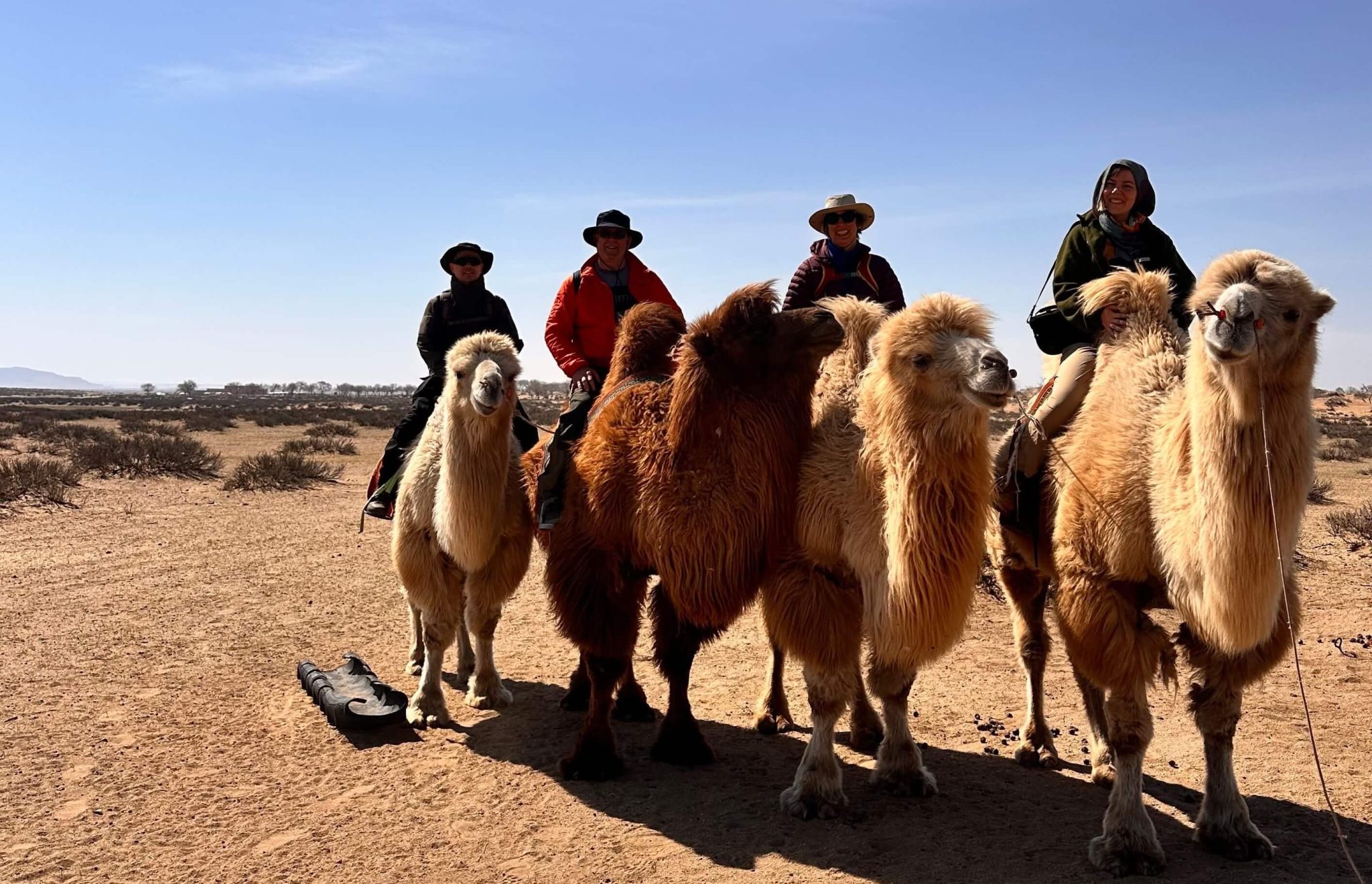
Table of Contents
The Bactrian Camel – Part of Mongolia’s History and Everyday Life
The domestic Bactrian camel (Camelus bactrianus) is instantly recognisable by its two humps and thick coat. It is remarkably well adapted to the extreme conditions of Mongolia’s Gobi Desert.
Unlike the single-humped dromedary, which is more commonly associated with hot deserts, the Bactrian camel is adapted to a continental climate where summer temperatures can be extremely hot and winter temperatures fall far below freezing.
Their humps store fat, providing an energy reserve when food is limited. Their broad, padded feet help them move across sandy and stony ground, while long eyelashes and closable nostrils offer protection against blowing sand and dust.
They can survive on sparse vegetation, including tough and thorny desert plants, and are remarkably efficient at conserving water.
For Mongolian herding families, camels have traditionally provided transport, milk, wool and other resources. In parts of the Gobi, camel milk is fermented to make khoormog, a drink that remains part of the region’s food culture.
Although vehicles have replaced many of the camels’ former transport roles, they remain important to families in the Gobi.
And while it is easy for visitors to see a camel as simply something to ride, for the herders who own them, they are part of a much wider relationship between livestock, livelihoods, land and seasonal movement.

Why We Recommend a Longer Camel Trek
Many visitors to Mongolia’s Gobi Desert experience camel riding as a short activity, perhaps for an hour at the foot of the sand dunes. There’s nothing inherently wrong with wanting to try a short camel ride, but we have always felt that travelling by camel becomes a much more interesting experience when you have time to go somewhere.
The purpose changes. Instead of simply riding a camel, you are making a journey through a landscape, accompanied by people who have spent their lives living and working within it. You begin to notice more of the smaller details: the vegetation growing in apparently dry ground, the changing shape of the dunes, the animal tracks in the sand and the way the light changes over the mountains.
You also become more aware of the practicalities of travelling this way. Camels have their own pace, and the route is shaped by the weather, terrain, the animals and the decisions of the herder travelling with you.
It’s a very different way of experiencing the Gobi from covering the same ground in a vehicle.
Five Days Around Khongoryn Els – Our Own Camel Trek
Having visited Khongoryn Els many times and climbed its enormous dunes on numerous occasions, I had long wanted to explore what I thought of as the ‘other side’.
Most visitors spend time along the northern side of the dune field, where the Khongoryn Gol supports vegetation and herding families live nearby.
But I wanted to explore the quieter southern side, towards Sevrey, and the surrounding landscapes beyond the main visitor areas.
We could have reached parts of this area by vehicle. Instead, we decided to make a journey of it, choosing a five-day camel trek that would take us through the natural sandy passage across the dunes and into the landscapes beyond.
One of our local hosts at Khongoryn Els is Baasankhuu, who grew up in a herding family in the area. When we first met him, he lived at Khongoryn Els throughout the year. Family commitments now mean he divides his time between the dunes and Ulaanbaatar, although his sister continues to live in the area year-round.
For our trek, Baasankhuu arranged for us to travel with Bagi, a local camel herder.
Travelling through this landscape with Bagi brought a different understanding of the places we passed through. They weren’t simply locations on a map. They were, and remain, places associated with pasture, water, livestock and family histories.
Springs, Saxaul Woodland and Leaping Wolf
Our route took us through a variety of landscapes, including the spring at Seruun Bulag and Uujim Pass, a natural passage through the dune system that has long provided a route between the landscapes to the north and south.
We also travelled through the saxaul woodland of Zuun Shurguul, where Baasankhuu’s family once had their spring pasture, and Chono Kharaikh, or Leaping Wolf, one of those wonderfully named places that stays in your memory. Throughout parts of the journey, the Zoolon Mountains formed a backdrop.
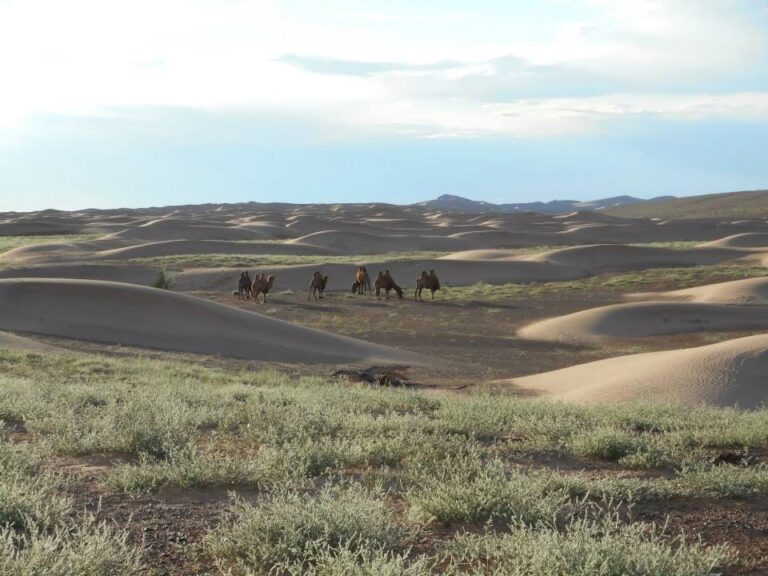
The landscape here is far more varied than you might expect. There are open desert plains, areas of vegetation, springs, woodland and mountain foothills, all within reach of the enormous dunes.
We camped among the dunes, and I remember how different the landscape felt once we were away from the main visitor areas.
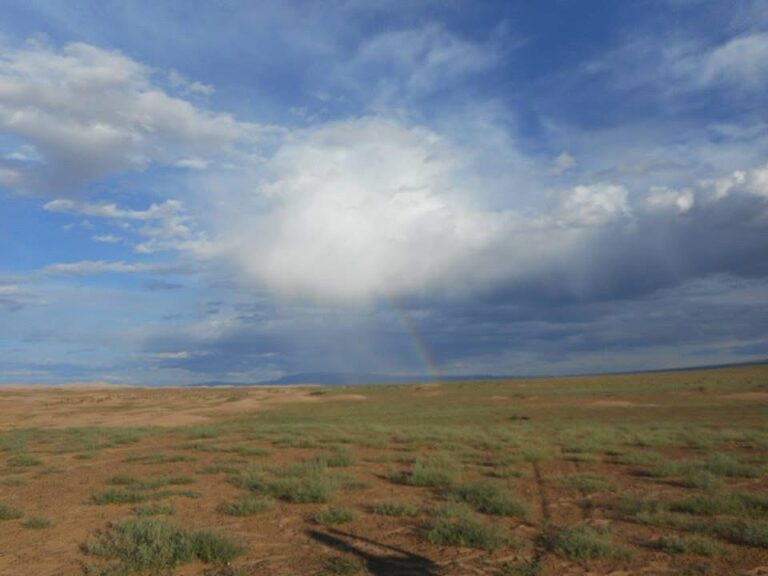
One night, a storm came through and reminded us just how exposed you can be in the Gobi. On another, wolves approached our camp during the darkness, something we only discovered from the tracks they had left near our tents the following morning.
Those five days changed the way I thought about Khongoryn Els. Somewhere I already knew well became somewhere I was discovering again.
And that is one of the things I value most about travelling in Mongolia. There is nearly always more to a place than its best-known viewpoint.
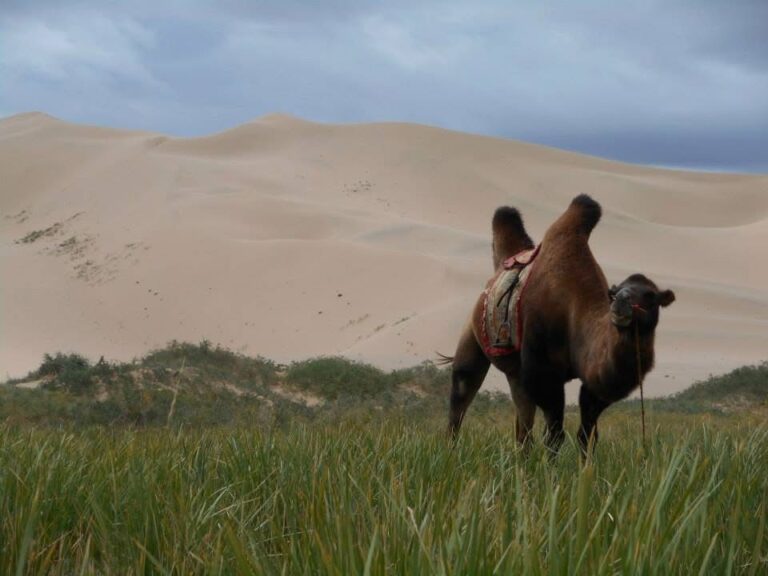
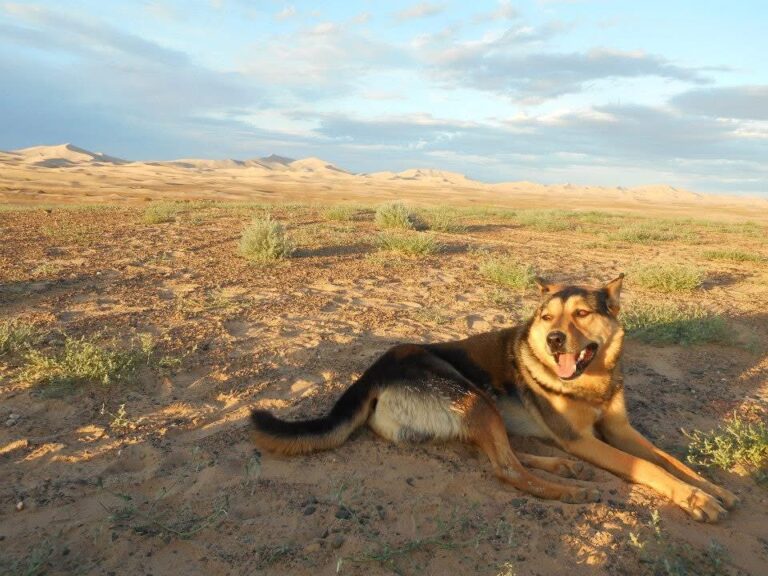
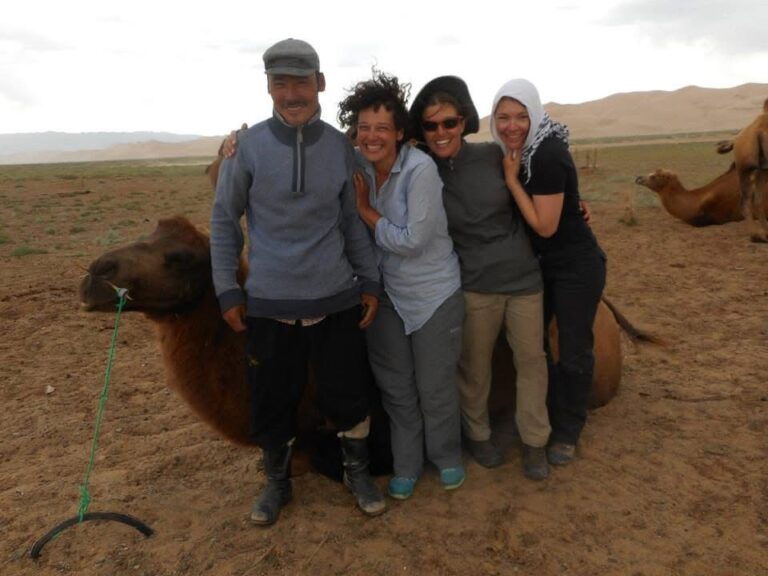
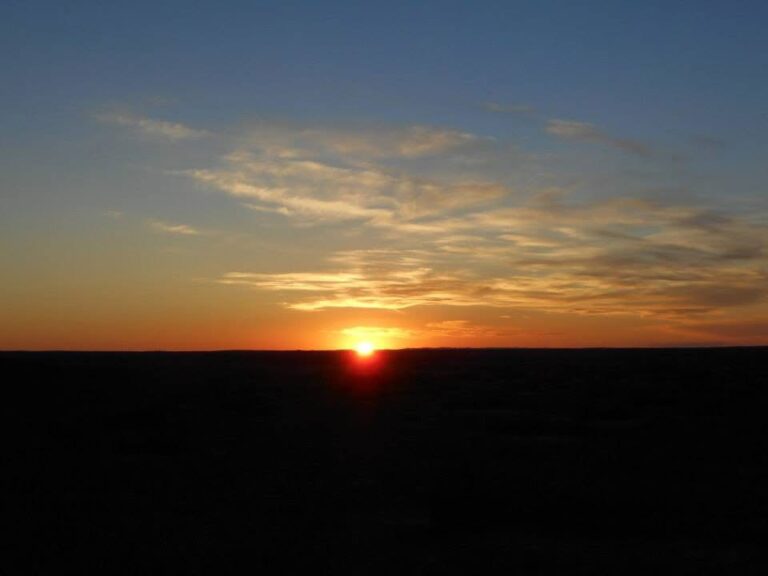
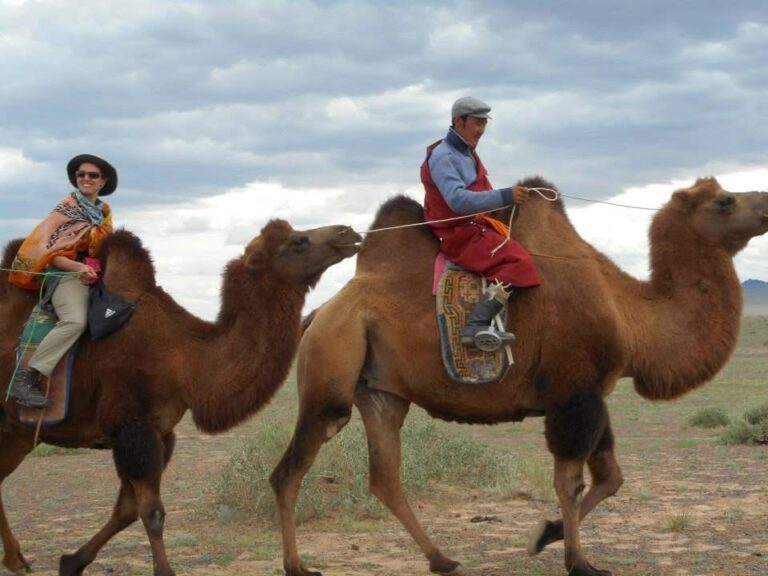
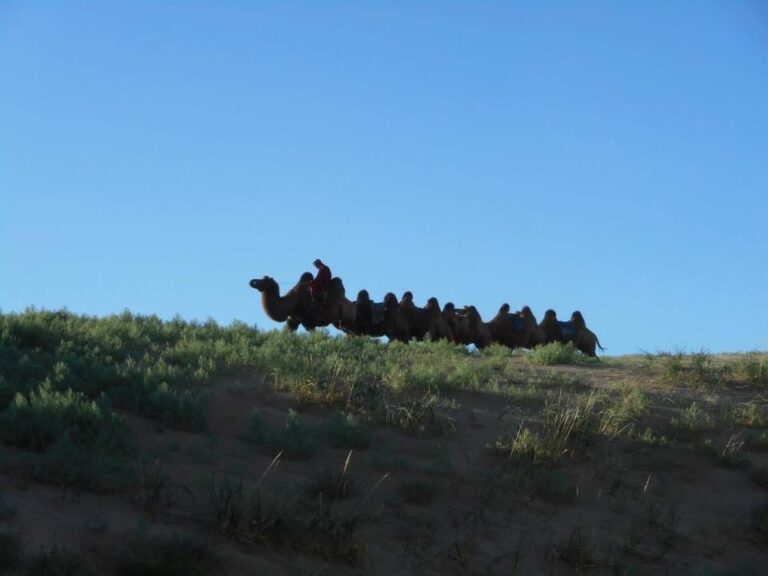
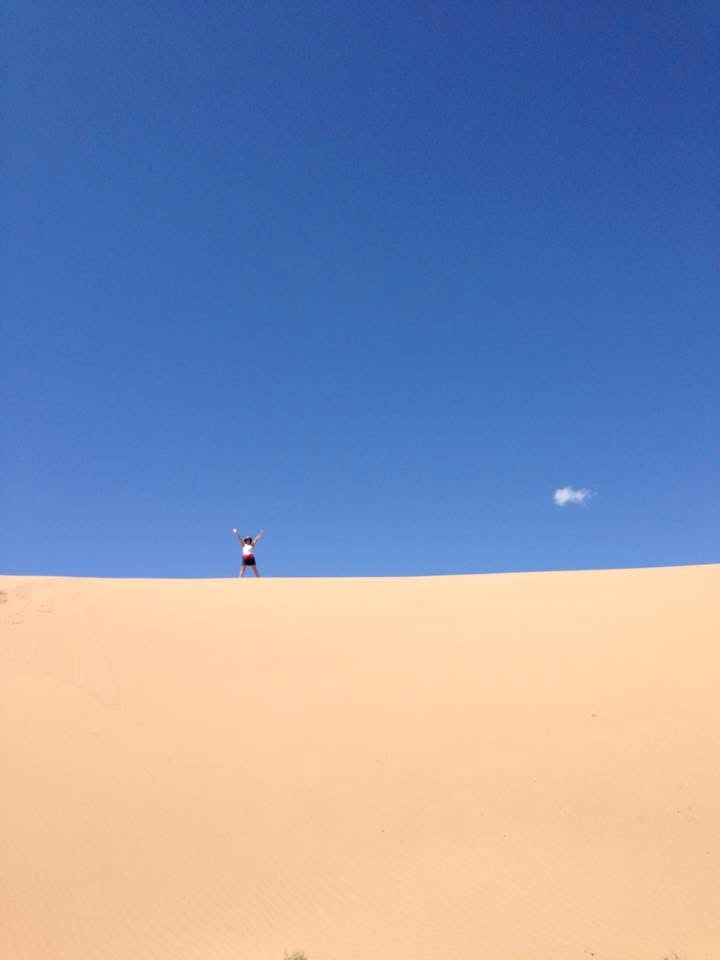
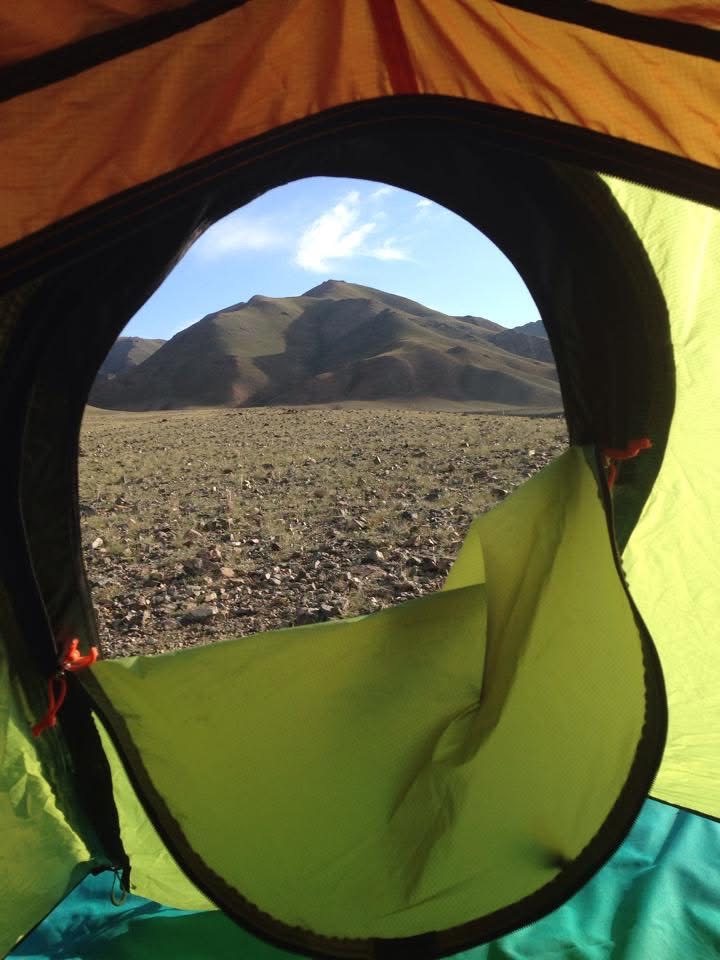
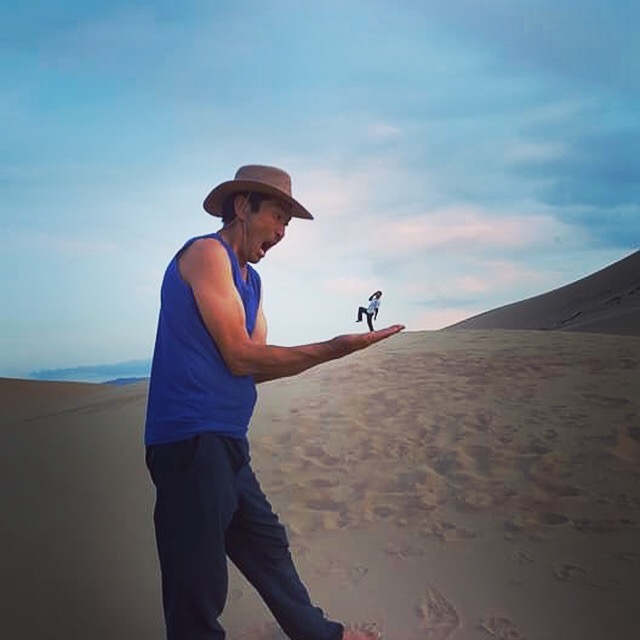
Here’s a collection of informal snapshots from one of our five-day camel treks – not polished photographs, but little glimpses of the landscapes, people and moments that made the journey memorable.

What Is a Longer Camel Trek Actually Like?
A longer camel trek isn’t about riding for as many hours as possible or covering the greatest distance.
We plan these journeys to allow time for breaks, for the animals to rest and for people to enjoy where they are.
The route and daily distances depend on conditions, the herder’s advice and the experience and comfort of the participants.
Our extended treks are vehicle-supported, which means our team carries the main camping equipment and supplies. You aren’t expected to be entirely self-sufficient or to remain on a camel throughout the journey.
If you need a break from riding, there is the option of travelling in the support vehicle where the route and terrain allow.
Accommodation is in tents, with simple camping facilities provided by our team. This is not a luxury camping experience, but neither is it an expedition where you are left to manage everything yourself.
Part of the enjoyment is the rhythm of each day – preparing to leave camp, travelling alongside the camels, stopping for food and eventually finding somewhere to settle for the night.
It’s also about the company.
Our camel herders, such as Bagi, are not conventional tourist guides. They bring their own experience and knowledge of the animals, the routes and the landscape, while our Eternal Landscapes team supports the wider journey.
Previous guests have remembered the extraordinary colours of the evening sky, the stars, climbing the dunes in the cool of the morning and playing cards with their camel herder in camp.
Interestingly, their memories have tended to focus on these moments rather than the physical act of riding a camel.
Working With Local Camel Herders and Their Camels
Our camel trekking experiences are arranged through long-standing relationships with local herders.
The families we work with have their own lives, responsibilities and seasonal commitments. Tourism is one part of their livelihoods, rather than the sole purpose of their animals or their presence in the landscape. Their camels are working animals, part of their everyday livestock herds, and spend much of their time roaming and grazing freely before being gathered for a trek.
This distinction matters to us.
We don’t expect the herders to perform a particular version of Mongolian culture for our guests. Their role is to accompany the journey, look after their camels and share their knowledge in whatever way feels natural, with our team helping to bridge any language differences.
Travelling with them also means that decisions about routes and conditions are informed by local knowledge. A spring that appears as a small name on a map may have been used by a family for generations. An area of woodland may be part of a seasonal pasture. A track through the dunes may be a route that local people have used long before recreational trekking became part of tourism.
Animal welfare is also a consideration. As is common in Mongolia, the camels have nose pegs, which allow herders to guide and control them using a rope. We recognise that this traditional practice raises welfare concerns, as nose pegs can cause discomfort or injury, and we believe it is important to be transparent about their use. We don’t carry out formal animal welfare inspections, but we work with herders we know and plan our treks around the animals’ pace, allowing time for rest and grazing. We also understand and respect that some travellers may prefer not to participate in camel riding.
Ultimately, what we hope visitors take away from these journeys is not simply the experience of riding a camel, but a greater understanding of the landscape and the people and animals whose lives are connected to it.
A Guest’s Perspective on Camel Trekking
Our five-day camel trekking experience was also part of one of our Wild Gobi research journeys.
Sovay Berriman, who joined the experience, described the landscape and journey in her own words:
“Six Mongolian Bactrian camels took us across the foot hills of the mighty sand dunes of Khongoryn Els, led by Bagi, a local herder and, our guide. The dunes of Khongoryn Els sweep up against Zöölön Uul, a mountain range that is at the easterly reach of the Gobi Altai. You could say the dunes were a mountain range themselves. They are mammoth, the highest peak of sand being approximately 300m. They present the stereotypical beauty I think of in relation to a desert; sweeping lines and sharp contrasting forms lit by an unforgiving sun. There is certainly a beauty here…”
Exploring Mongolia’s Gobi by Camel
We don’t include a five-day camel trek in any of our published tour itineraries, but we can arrange longer camel trekking experiences as part of a tailor-made journey through the Gobi.
We generally recommend allowing at least two days for a camel trek, although five days gives you considerably more time to explore beyond the most frequently visited areas of Khongoryn Els.
These aren’t fixed itineraries that run identically every time. Routes need to be planned around the season, the conditions, the herders and their animals.
For us, that’s part of the appeal.
Mongolia’s Gobi has a long history of people travelling through it with camels, from the old trading caravans to the families who continue to use them today.
A camel trek is not a recreation of those historic caravan journeys. Our journeys are shorter, supported and undertaken for very different reasons. But travelling at the pace of a camel offers a different perspective on the distances, landscapes and practicalities that shaped those earlier journeys.
And perhaps that is what I value most about them: the opportunity to experience somewhere familiar in an unfamiliar way.
You can discover more about the landscapes and people of the region in our guide to Mongolia’s Gobi Desert or explore our Khongoryn Els Sand Dunes article.
Jess @ Eternal Landscapes Mongolia