A Landscape Shaped by Wind
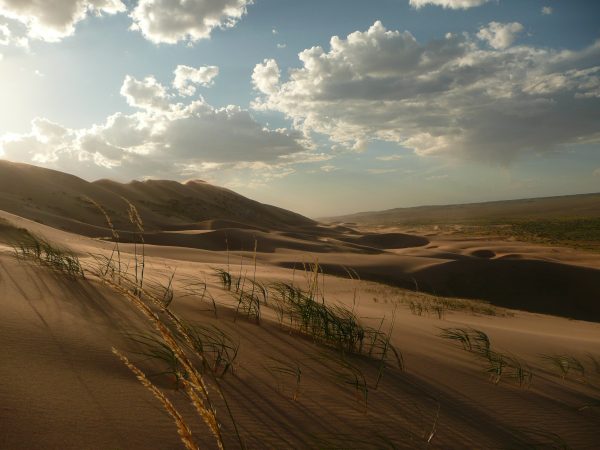
Khongoryn Els stretches for approximately 180 kilometres, with sections reaching around 12 kilometres in width. The highest dunes rise more than 200 metres above the surrounding valley floor, particularly towards the northwestern end of the dune field.
The dunes lie between the Bayan Tsagaan Mountains to the north and the Zoolon and Sevrey mountain ranges to the south. Their position is no coincidence.
The surrounding mountains help channel the prevailing winds through the valley. Over time, sand carried by these winds has accumulated into the enormous ridges that dominate the landscape today.
Although the dunes appear permanent, the sand itself is constantly moving. Wind reshapes the ridgelines, creates ripples across the surface and shifts grains from one place to another. The overall dune system remains, but its smaller details are continually changing.
Even the colours appear to change throughout the day, from pale gold and cream to deeper shades of amber as the angle of the light changes.
One of the more surprising features is the moisture that can sometimes be found beneath the dry surface sand. The dunes are not simply an enormous pile of completely dry sand. Their relationship with the surrounding geology, underground moisture and local climate is considerably more complex.
Why Are Khongoryn Els Called the Singing Sands?
One of the most distinctive features of Khongoryn Els is the sound the sand can sometimes make.
Under particular conditions, when dry sand grains move together down the slope of a dune, they can produce a deep humming or rumbling noise. This is why the dunes are known locally as
Duut Mankhan – the Singing Sands.
 The sound is created by the synchronised movement and vibration of countless grains of sand. It can resemble a distant aircraft or a low, prolonged musical note.
However, the dunes do not sing all the time. The sound depends on factors including the dryness of the sand and the way the grains move. Some visitors hear it, while others experience only the sound of the wind.
And that is part of visiting a natural landscape. Not everything happens to order.
Life Along the Khongoryn Gol
One of the things we particularly appreciate about Khongoryn Els is the contrast between the enormous sand dunes and the narrow ribbon of green at their base.
The Khongoryn Gol is a small river that runs along part of the northern edge of the dunes. Although modest in size, it plays an important role in the local ecosystem.
Water supports grasses, other vegetation and small areas of wetland, creating a habitat for insects, birds and other wildlife. Bird species recorded around the dunes and wetter areas include northern lapwings, desert wheatears and Pallas’s sandgrouse.
The river also helps make this landscape suitable for herding families and their livestock.
This is something easily overlooked when visiting the dunes purely for the scenery. Khongoryn Els is not an empty wilderness. It is part of a working landscape where local families continue their lives alongside the rhythms of the seasons, the availability of water and the needs of their animals.
The presence of the herding families is as much a part of understanding this region as the sand dunes themselves.
Spending Time at Khongoryn Els
Khongoryn Els is one of the Gobi’s best-known visitor destinations. Many travellers arrive towards the end of the afternoon, climb the dunes and stay to watch the sunset.
Understandably so. The views from the dunes are extraordinary, particularly as the evening light brings out the shapes and shadows of the ridgelines.
But visiting Khongoryn Els doesn’t have to be only about reaching the highest point or taking a photograph.
We believe there is value in spending longer here, allowing time to appreciate the scale of the landscape and the smaller details within it.
This might mean walking along the base of the dunes, watching the changing light, observing birdlife around the river or spending time with one of the local host families.
It might also mean heading away from the most frequently visited sections of the dunes on a longer camel trek.
Our extended four or five day
camel trekking experiences offer a different way of exploring the area. Travelling at a slower pace, alongside local camel herders, provides an opportunity to experience the landscape beyond the main visitor stopping points.
The Legend of the Camel, the Deer and the Horse
If you have visited Khongoryn Els, or are planning a journey there, you may notice a rather unusual statue at one of the main tourist camps as you approach the dunes: a camel with antlers. It might seem a curious sight, but there is a traditional Mongolian legend behind it.
Long ago, when animals could talk, the camel had magnificent antlers and a long, thick tail. One day, while drinking from a river and admiring his reflection, a deer approached him.
“Hello, Camel,” said the deer. “I have been invited to an assembly of animals this evening, but my forehead is so bare. I wish I could go with beautiful antlers like yours. Could you lend me your antlers for tonight? I’ll return them tomorrow when you come for a drink.”
The camel, proud of his antlers but kind-hearted, took pity on the deer and agreed.
“Return them tomorrow when I come for a drink,” he said.
The deer thanked him and went on his way.
On his journey, the deer met a horse and explained how he had borrowed the camel’s magnificent antlers.
The horse then approached the camel, who was still beside the river.
“I’m going to a horse race,” said the horse, “and I’m sure I would win if I had your beautiful tail.”
“No,” replied the camel. “I have already lent out my antlers. I can’t lend out my tail as well.”
“Don’t worry, brother,” said the horse. “I’ll bring it back tomorrow after the race.”
Eventually, the camel agreed.
“Alright, but make sure you bring it back,” he said, handing over his long, bushy tail.
But tomorrow came and went. Then weeks, months and years passed. Neither the deer nor the horse returned what they had borrowed.
The camel repeatedly asked for his antlers, but the deer always replied:
“I’ll give you back your antlers when the goat’s horns have grown to heaven, and the foolish camel’s tail has grown down to the earth.”
And so the camel never got his antlers or his tail back.
According to the legend, this is why the camel sometimes shakes his head sadly when drinking from a river. And why, at other times, he stretches his neck and gazes into the distance, still hoping to see the deer and horse returning what belongs to him. It’a also why the deer must shed and regrow his antlers each year because they originally belonged to the camel. And the horse, knowing he never returned the tail, shies away whenever he meets a camel.
It is a lovely story to remember when spending time among the Bactrian camels of the Gobi.
Exploring the Gobi Beyond Khongoryn Els
Khongoryn Els is one of Mongolia’s best-known natural landmarks, but it is only one small part of the Gobi.
The wider region is a landscape of contrasts, from rocky mountain ranges and desert plains to small settlements, herding communities and places of geological and historical significance.
For us, travelling through the Gobi is as much about the journeys between these places as the destinations themselves.
It is about the roadside stops, the conversations, the ordinary details of life and the people who call this immense landscape home.
If you would like to spend time exploring Khongoryn Els and the wider Gobi region, have a look at our
guide to Mongolia’s Gobi Desert.
You are also welcome to get in touch if you would like to explore this remarkable region with us.
Jess @ Eternal Landscapes Mongolia