
Eagle Hunting in Western Mongolia: Tradition, Seasonality and Reality
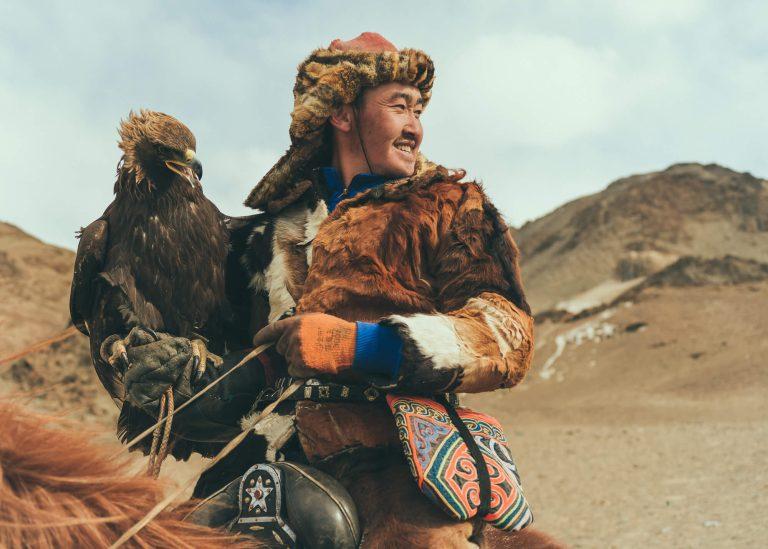
Eagle hunting in western Mongolia is often represented by a single dramatic image — a hunter on horseback, a golden eagle poised against winter mountains. But behind that photograph lies a complex, seasonal tradition shaped by land, weather, family knowledge and restraint. This article offers an introduction to how eagle falconry is practised today, and what it truly means to spend time alongside Mongolia’s Kazakh eagle hunters.
Table of Contents
Kazakh Eagle Hunting in Mongolia: History and Cultural Roots
In 2021, UNESCO added Kazakh eagle hunting to the List of the Intangible Cultural Heritage of Humanity as an example of living human heritage. But falconry is not a modern invention shaped by tourism. Hunting with birds of prey has taken place across the steppe and mountain landscapes of Central Asia for centuries. It is a tradition that suits wide open land, passed quietly from one generation to the next, and within Mongolia it remains a core cultural element of the Mongol Kazakh population.
Golden eagles are chosen for their agility, speed and exceptional eyesight, able to spot prey across vast snow-covered terrain. Female birds are preferred as they are larger and more powerful. Eagles are taken from the wild when young, trained over many months, and later released while still of breeding age. Their wings are not clipped and they are not caged, although they do wear a tomaga (hood) when at rest.
To Western eyes the relationship can appear harsh, but these are not pets — they are working animals. It is closer to the bond between a farmer and a sheepdog than to companionship. Spend time with a hunter and their eagle and you begin to see that the partnership is shaped by trust, familiarity and respect.
Each hunter is different in how they capture and domesticate their eagle. Although the traditions and skills of hunting with eagles are passed down culturally, there is no set rule as to how it is done. Some of the hunters learn from their fathers or older brothers. Some learn from their sisters. Hunters can be male or female, young or old. Hunting with eagles can be done on foot or horseback. Some of the hunters own more than one eagle.
Women Eagle Hunters in Western Mongolia: Apprenticeship and Tradition

Ahkelik, like many young female huntresses in western Mongolia, practises eagle falconry alongside school and domestic life. This does not make her role any less valid. The traditional measure of a berkutchi may be a multi-day winter hunt on horseback, but that benchmark reflects physical realities as much as cultural ones. A female golden eagle can weigh up to six or seven kilograms, and when hunting the rider must gallop one-handed with the bird balanced on their forearm, often in extreme cold.
Many young women are fully capable of these conditions, but when they do hunt it is usually alongside male relatives — fathers, brothers or grandfathers — who provide guidance and safety across difficult terrain.
Even when they do not actively hunt, young female eagle hunters value the ownership and training of their birds for the freedom it brings, for enjoyment, and for the way it connects them to older generations. Apprenticeship typically begins in the early teenage years, when knowledge is passed informally within families. Like many young Mongolians, women often leave for university, and it is at this point that eagle hunting usually pauses as they move away from their home communities. Yet during those formative years of training and care, traditions are transmitted in a living way through daily practice.
When Eagle Hunting Happens: Winter Season, Moult and Rest Periods
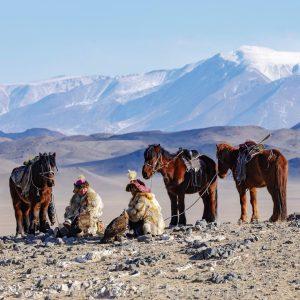
Eagle hunting is a winter activity. Snow cover helps birds detect fleeing prey, and hunting traditionally takes place when animals such as hare, marmot and fox carry thick winter coats.
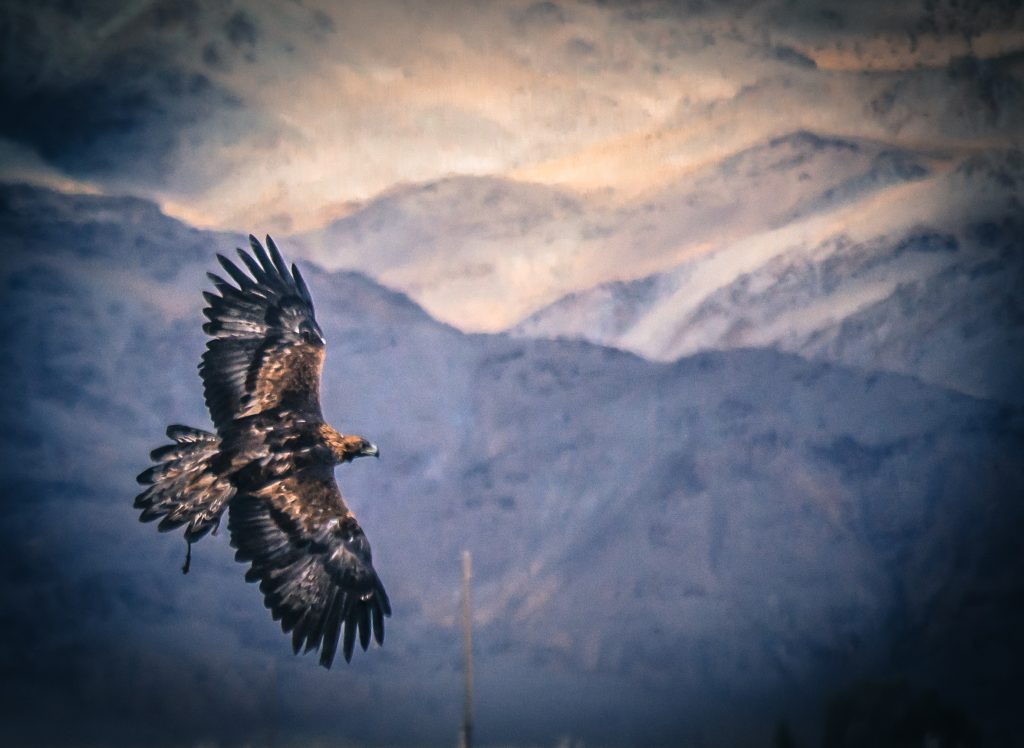
The landscapes of western Mongolia fit perfectly with the way golden eagles naturally hunt – either by soaring above the landscapes scanning the ground for prey or by perching on a rock and scanning the ground below for movement.
In summer, hunting stops entirely. Prey species are raising young and eagles enter their annual moult from around March to May.
During this time the birds are rested, tethered near streams on summer pastures, and largely left undisturbed. If you visit in summer, do not expect to witness a hunt — it is not part of the Kazakh calendar and would be contrived although training demonstrations take place.
What It’s Really Like to Accompany an Eagle Hunter in Mongolia
Hunting with eagles is part of each hunter’s identity, but it does not happen on demand. Spend time alongside them and you begin to see that this is a learned practice — built slowly through trust and communication between human and bird.
Not every hunt is successful, and as an observer you may miss the moment entirely. Leave your expectations behind. In the winter landscapes of western Mongolia, schedules dissolve — you move on nomad time.
And it is never only about the hunt itself. It’s about continuing a tradition, being in the deep silence of the winter landscapes, and also experiencing skilled horsemanship and other aspects of the Kazakh culture.
Kazakh Eagle Hunter Festivals in Bayan-Ölgii: What to Expect

Throughout the year, eagle festivals take place across western Mongolia. The larger, established events are partnerships between the Mongolian Eagle Hunters’ Association (or similar local organisations) and tour operators, first developed in the late 1990s and early 2000s to bring visitors to what was then a remote and little-visited region. At heart, these gatherings resemble a summer community fête — one where international travellers mix with eagle hunters, horsemen and local families, with children, parents and grandparents travelling in from nearby towns.
Alongside these flagship festivals, there are now many smaller, more informal events. Some are organised within local communities, while others mark important dates in the annual calendar such as Nauryz, the Central Asian New Year. Festival competitions showcase traditional falconry skills and the communication between hunter and eagle. Judges assess not only the hunter, but also the eagle and horse, scoring appearance, responsiveness and precision. Events include tests of how quickly and accurately an eagle returns to the hunter’s glove, as well as its willingness to attack a dragged pelt.
Because eagles rest through the summer while they moult, these autumn festivals often follow a long period of inactivity. Communication between hunter and bird may be unpractised — and it is not uncommon for eagles to ignore their handlers entirely, to the amusement of the gathered Kazakh audience.
In response to rising visitor numbers, the largest festival organisers now work with the Wildlife Science and Conservation Centre of Mongolia to develop systems for managing tourism responsibly, protecting wild eagle populations, and placing community-led accountability at the heart of festival planning. Alongside this, the newly established Eagle Hunter Cultural Centre opened in October 2024. Founded by the non-profit Cultural Sanctuaries Foundation in partnership with the Kazakh Falconry Association, the Wildlife Science and Conservation Center of Mongolia, the Bayan-Ölgii provincial government, Nomadic Expeditions and local community members, the centre aims to deepen understanding of the eagle hunting tradition while celebrating the culture and landscapes of western Mongolia.
Visiting Western Mongolia With Understanding
In a region where climate and landscape shape daily life in unpredictable ways, tourism can offer an important additional income. But the reality of eagle hunting is inseparable from season, place and family rhythm — and visitors who arrive with this in mind experience far more than a single moment.
A few things to hold in mind:
- Season matters: Eagle hunting is a winter practice. Snow, cold and long days on horseback are part of its reality. Outside this season, hunting simply does not take place, and it is normal not to see a hunt at all.
- Time with the eagle hunters and their families is the experience: Falconry makes sense only when placed within daily life. As part of the experience, you should take time to learn about the way of life of the Mongol Kazakh eagle hunters and their families as listening to stories, helping with small tasks, and learning how families live brings understanding that no demonstration can offer.
- Eagle hunters are one part of a wider community: Mongol Kazakh life includes herders, teachers, shopkeepers and families living in provincial towns. Eagle hunting sits within this broader social landscape and to only want to experience the way of life of the eagle hunters is to dismiss an integral part of the local culture and population. https://eternal-landscapes.co.uk/the-mongol-kazakhs-of-western-mongolia/
- Small groups work best: Eagles are wild birds. Smaller groups allow both birds and hosts to remain at ease, and create space for genuine interaction.
- How you travel shapes what you see: Travel with people or companies who know families personally and who treat time, payment and access with respect.
You can find out more in our online guide to eagle hunting and the culture of western Mongolia.
If our way of travelling resonates with you — slower, grounded in relationships, and shaped by the seasons rather than tourism demands — you are welcome to join us in western Mongolia. Our journeys are built around time spent with families we have worked alongside for many years, allowing space to understand daily life rather than rush through highlights. You can explore our western Mongolia experiences through the links above, or simply get in touch to talk through what might feel right for you.
Jess @ Eternal Landscapes