
The Mongolian Herding Calendar
Across Mongolia’s vast landscapes, herding families move with the seasons — birthing in spring, milking through summer, preparing in autumn, enduring winter. The Mongolian herding calendar offers insight into a way of life guided by livestock, weather, and generations of knowledge.
Table of Contents
Out of Mongolia’s population of approximately 3.2 million (2020 Census), around 230,000 households continue a herding way of life. Together they manage roughly 71 million head of livestock (December 2022 figures), moving between seasonal pastures throughout the year.
Daily life is dictated by season, weather, and the needs of the animals — often referred to as the Five Snouts: sheep, goats, cattle (including yaks), camels, and horses.
Each season brings distinct responsibilities: birthing, milking, combing, shearing, migrating, repairing shelters, preparing for winter. There is no static routine. The calendar is practical, responsive, and deeply tied to environment.
What follows is an overview of the annual herding cycle, drawn from the families we work with through long-term community partnerships. Mongolia is vast and ecologically diverse, so patterns vary by region — sometimes even between neighbouring districts.
Climate Change and a Changing Pastoral Life
Mongolia’s pastoral system is under increasing pressure.
Since 1940, average temperatures have risen between 1.8–2.2°C. Combined with shifting precipitation patterns and economic change, this has altered migration rhythms and pasture availability.
Where some families once migrated six to eight times per year, many now move only twice. Others relocate closer to towns to access markets or ensure education opportunities for their children.
These shifts do not signal the end of herding life — but they do require adaptation. Mongolia’s herding communities remain resilient, adjusting practices while holding onto core knowledge passed through generations.
If you’re curious to learn more, we recommend this insightful article written by a Mongolian Ph.D. candidate, now based in Ulaanbaatar, who grew up in a herding family. It offers a firsthand perspective on how climate change and modernisation are reshaping nomadic life.
Spring (March – Early May)
Birth, Fibre, and Movement
Early spring begins in winter camps. Snow may still cover the ground. Winds can be severe.
By mid-March, birthing season begins.
Lambs, kids, calves, foals, and camel calves arrive — often in extraordinary numbers. Survival rates depend on vigilance, weather, and shelter. Nights are long. Days are full.
Goats are hand-combed for cashmere as they naturally shed their undercoat. Castration of young male livestock is carried out to manage breeding and strengthen herd quality.
As temperatures rise, families prepare to move toward spring or early summer pasture — typically areas closer to reliable water sources. Wells must be cleared of ice. Gers and equipment damaged by winter storms are repaired. Lactation begins, and milking resumes.
Spring is demanding. It is also a season of renewal.
Bactrian Camels and Fibre
In the southern Gobi, conditions are particularly extreme — searing summers, freezing winters, and powerful winds in transitional seasons.
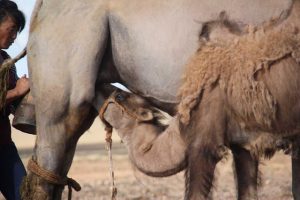
The two-humped Bactrian camel is uniquely adapted to this environment. Its wool has natural thermostatic properties, insulating against winter cold while allowing heat regulation in summer.
Traditionally, herders collected camel wool as it was shed. Today, shearing is more common, although wool over the humps is often left intact to provide protection during sudden spring storms.
Camel wool is widely used in Mongolia for garments and textiles.
Cashmere, another spring fibre, remains one of Mongolia’s most economically significant exports. The fine, long fibres produced by Mongolian goats are highly valued internationally. Spring combing provides crucial post-winter income for rural families.
Summer - Late May to early September
Growth, Milk, and Preparation
Summer is about pasture.
Livestock are guided toward nutrient-rich grazing to build strength before winter. Sheep and goats are often herded together; horses, cattle, camels, and yaks may graze separately depending on terrain.
Milking becomes central to daily life. Tsagaan Idee — Mongolia’s traditional dairy foods — are produced in abundance.

There are regional variations, but Mongolian dairy products can broadly be classified as fat-based, protein-based, or fermented. They range from sun-dried curds known as aaruul to airag — fermented mare’s milk and one of the most recognisable drinks of the summer season.
When milk or by-products are collected in small quantities, they are often accumulated over several days, allowed to sour naturally, and then processed. Nothing is wasted.
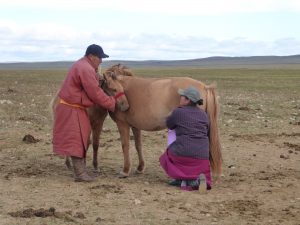
Mares are typically milked beginning in early July around the time of the Naadam Festival. They may be milked six or seven times daily. The milk is fermented into airag (fermented mare’s milk), which contains a mild alcohol content of approximately 1.5–2.3%.
Fermentation traditionally takes place in a large skin sack or container, stirred hundreds of times daily with a wooden masher. Anyone entering or leaving the ger may contribute a few strokes — a small but meaningful communal gesture.
Meanwhile, Naadam horses undergo rigorous training in preparation for the Naadam Festival, held countrywide in July, where horse racing is a major event.
Sheep shearing also occurs in summer. While sheep wool has limited commercial value, it remains essential for making eskii — the felt that insulates gers.
Children return home from school in early June and become active participants in herding life. Summer is labour-intensive but also social and communal.
Autumn - September and October
Preparation and Provision
Autumn is a transitional season.
Livestock continue grazing to maximise weight before winter. Milking gradually reduces, though practices vary by household.
Wool and hair are processed into felt and garments. Where possible, hay is cut and stored for winter fodder.
September also marks the beginning of the school year. For many families, this requires careful financial planning. Some sell livestock; others take loans to cover educational costs.
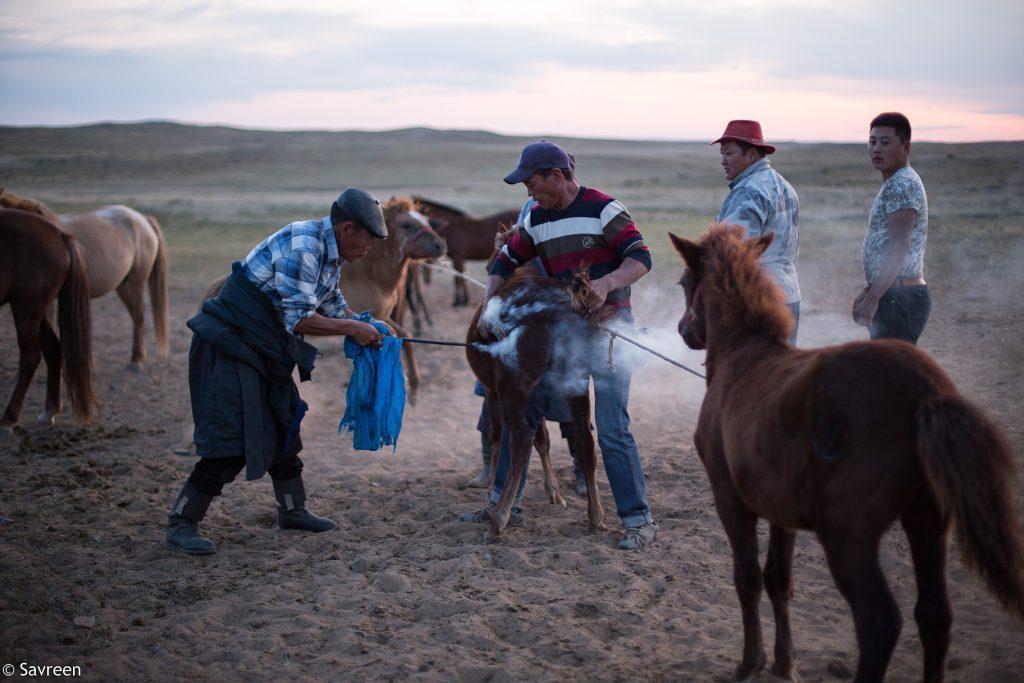
Winter shelters are reinforced. Gers are prepared for additional felt layers. Livestock numbers may be reduced to balance available winter feed. Young horses are branded to establish ownership.
Autumn is purposeful and practical — focused on readiness.
Winter - November to February
Endurance and Shelter
During the winter months, Mongolia’s herding families settle at their winter pastures, where survival becomes the primary focus. Water sources are scarce and often frozen, so families collect drinking water from nearby water points, such as frozen rivers, wells, or by melting ice. Despite the harsh conditions, herding continues, with a strong emphasis on protecting livestock from predators like wolves and ensuring that animals can reach feed buried beneath the snow.
To withstand the extreme cold, gers are insulated with extra layers of felt, and animal shelters are fortified with dung insulation to trap warmth. Protecting both the family and the livestock from the severe winter weather is essential.
With limited daylight and relentless cold, life during winter often feels like a semi-hibernation for herding families. Tasks are done efficiently, and evenings are spent indoors, conserving energy and warmth.
Regional Variations
The seasonal rhythm described above shifts depending on geography.
In areas such as Khustain Nuruu National Park, winter camps may include enclosed shelters behind the gers to protect sheep and goats from wolves.
In the southern Gobi, families such as those near Tsagaan Suvarga experience particularly harsh wind exposure and vast open terrain.
Each region adapts the calendar to its environment.
Tsagaan Sar
One of the few breaks from the routine comes with Tsagaan Sar, the Mongolian Lunar New Year (also known as the White Month), celebrated in late January or February. This holiday marks a time for families to come together, share traditional foods, and honour both the past year and the new beginnings ahead.
Winter is a season of endurance, requiring resilience, resourcefulness, and a deep connection to the rhythms of nature. Despite the challenges, Mongolia’s herders continue to uphold their traditions, adapting to the season while protecting their animals and preserving their way of life.

Experiencing the Herding Year
The Mongolian herding calendar is not symbolic — it is economic, environmental, and lived.
Migration days are chosen according to the lunar calendar and elemental combinations believed to bring good fortune. Fibre gathering supports international supply chains. Dairy production sustains households. Livestock management determines survival.
For travellers, understanding this annual cycle offers far deeper insight than simply witnessing a single seasonal moment.
If you’re curious about experiencing pastoral life more closely, our Altai Migration experience allow you to join a family during seasonal movement. Our broader Mongolia journeys also include homestays with families we work alongside through long-term partnerships.
Our experiences are shaped by season, by livestock, and by daily life if you would like to join us.
Jess @ Eternal Landscapes